
コンテンツにスキップ

Japanese Bookmarks

  • Bookmark

    CATS (C.1830) BLACK

    £2.00

    Text on the reverse side: During the sixth century, Buddhist monks travelled from China to Japan accompanied by domesticated cats to guard over th...

    詳細を全部見る
    £2.00
  • Bookmark

    CAT NO.2

    £2.00

    Text on the reverse side: The way cats wash their faces licking their paws and wiping their face - it is as if they are inviting good luck beckoni...

    詳細を全部見る
    £2.00
  • Bookmark

    CATS (C.1830) WHITE

    £2.00

    Text on the reverse side: During the sixth century, Buddhist monks travelled from China to Japan accompanied by domesticated cats to guard over th...

    詳細を全部見る
    £2.00
  • Bookmark

    BOOK LOVING FOX

    £2.00

    Text on the reverse side: The Japanese word for fox is "kitsune". A regular subject in Japanese folklore, the fox is portrayed with intelligence a...

    詳細を全部見る
    £2.00
  • Bookmark

    MONKEY AND MOON (C.1910)

    £2.00

    Text on the reverse side: The Japanese word for monkey, “saru”, is a homonym for the Japanese word “expel” (also pronounced saru), meaning “dispel...

    詳細を全部見る
    £2.00
  • Bookmark

    DANCING FOX (C.1910)

    £2.00

    Text on the reverse side: The Japanese word for fox is "kitsune". A regular subject in Japanese folklore, the fox is portrayed with intelligence a...

    詳細を全部見る
    £2.00
  • Bookmark

    BLOSSOMS AND MOON

    £2.00

    Text on the reverse side: The blooming of cherry blossoms is a symbol of purity. Their spectacular bloom is enjoyed by many, but for a short perio...

    詳細を全部見る
    £2.00
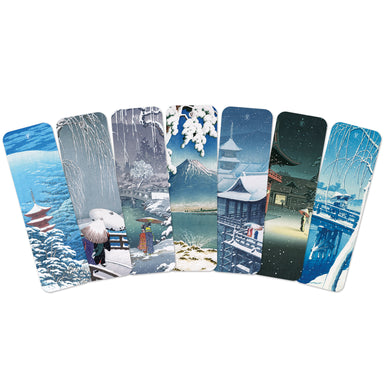
  • Bookmark

    WINTER WILLOWS (1937)

    £2.00

    Text on the reverse side: The willow tree is a symbol of grace and strength. The artist, Koitsu, was born in 1870, and often utilised the subtle u...

    詳細を全部見る
    £2.00
  • Bookmark

    LINGERING SNOW (1932)

    £2.00

    Text on the reverse side: One of the most commonly accepted origin of the name “fuji” is that the name sounds similar to “everlasting life.” Everg...

    詳細を全部見る
    £2.00
  • Bookmark

    TOGETHER (C.1910)

    £2.00

    Text on the reverse side: This image is recognised as one of Koson’s masterpieces. The bridge, particularly a bridge over water, represents crossi...

    詳細を全部見る
    £2.00
  • Bookmark

    KINGFISHER AND IRIS

    £2.00

    Text on the reverse side: The iris is associated with faith, hope, valour, and wisdom. It is a flower that has captivated the hearts of the Japane...

    詳細を全部見る
    £2.00
  • Bookmark

    HIROSAKI CASTLE

    £2.00

    Text on the reverse side: Back in 1715, the Tsugaru clan brought cherry trees from Kyoto and planted them in the grounds of Hirosaki Castle, Aomor...

    詳細を全部見る
    £2.00
  • Bookmark

    VIEW FROM MASSAKI (1857)

    £2.00

    Text on the reverse side: Hiroshige is considered to be one of the greatest Japanese print artists. From the window we see plum blossoms - traditi...

    詳細を全部見る
    £2.00
  • Bookmark

    EGRET IN WINTER (C.1910)

    £2.00

    Text on the reverse side: The egret is appreciated as an auspicious symbol in many cultures, representing independence, calm, grace and determinat...

    詳細を全部見る
    £2.00
  • Bookmark

    PUPPY (C.1800)

    £2.00

    Text on the reverse side: Hochu Nakamura (active 1790 - 1819), a Rinpa school Japanese painter from the middle to late Edo period, was mainly acti...

    詳細を全部見る
    £2.00
  • Bookmark

    PAPER CRANE OF PEACE

    £2.00

    Text on the reverse side: The paper crane is a powerful symbol of peace in Japanese culture. Its delicate form represents the beauty of harmony, w...

    詳細を全部見る
    £2.00
  • Bookmark

    SANKEI-EN

    £2.00

    Text on the reverse side: After collecting parts of buildings from various locations in Japan, a silk trader from Yokohama, Sankei Hara, began the...

    詳細を全部見る
    £2.00